Where AI, Cloud &
DevOps Innovation Happens
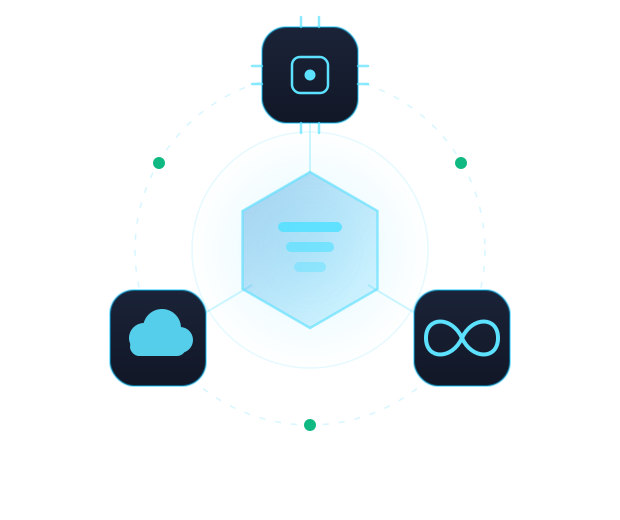
The Innovation Hub is where our engineers prototype, validate, and harden new approaches to AI, cloud, and DevOps — then turn what works into reference architectures and reusable modules our customers can adopt with confidence.
Engineering R&D, Not a
Marketing Lab
Every engagement teaches us something. The Innovation Hub is where we capture it. Our engineers take recurring customer problems — a migration pattern that keeps breaking, a pipeline that never scales, a model that costs too much to serve — and work them into tested, documented solutions.
Nothing reaches a customer environment straight from the whiteboard. Ideas are prototyped against real workloads, reviewed against our architecture practices, and only then promoted into the platforms and modules we ship.
- Prototypes validated on production-representative workloads
- Findings published as reference architectures and Terraform modules
- Every design reviewed against the six architecture pillars
- Vendor-neutral — proven across AWS, Azure, GCP, and on-premise
- Results fed back into customer engagements, not into slideware
Three Tracks, One Engineering Discipline
AI, cloud, and DevOps are not separate initiatives here. Each track feeds the others — models need platforms, platforms need pipelines, and pipelines need governance.
AI & Applied Machine Learning
We build the platform layer that makes AI safe to run in production — reproducible training, governed model promotion, and cost-aware inference — rather than treating models as one-off experiments.
- MLOps pipelines with versioned data and models
- LLM gateways with routing, caching, and spend caps
- Retrieval-augmented generation on private data
- AI-assisted incident triage and root-cause analysis
- Model evaluation and guardrails before promotion
Cloud Platform Engineering
Landing zones, tenancy models, and golden paths that let product teams self-serve infrastructure without filing tickets — and without stepping outside the guardrails your auditors care about.
- Multi-account landing zones as reusable Terraform
- Internal developer platforms and golden paths
- Policy-as-code guardrails enforced at deploy time
- FinOps tooling for showback and rightsizing
- Portability patterns across AWS, Azure, and GCP
DevOps & Delivery Automation
Pipelines that stay fast as the organisation grows: progressive delivery, automated rollback, and security checks that run on every commit instead of at the end of the quarter.
- GitOps-driven deployment across environments
- Progressive delivery with automated rollback
- Shift-left security and supply-chain attestation
- Ephemeral preview environments per pull request
- DORA metrics wired into delivery dashboards
Want to pilot one of these with your team?
We run short, scoped pilots against your own workloads — so you see evidence before you commit to a programme.
Six Pillars Every Design Is Reviewed Against
Innovation without discipline creates technical debt. Every prototype that leaves the Hub is assessed against the same six pillars we apply to customer architectures — and it does not ship until it passes.
Operational Excellence
Runbooks, automation, and observability are designed in from the start. If a system cannot be operated at 3am by someone who did not build it, the design is not finished.
Security by Default
Least privilege, encryption in transit and at rest, and identity-first access control are baseline requirements — not hardening steps bolted on before a go-live review.
Reliability
Failure is assumed. We define explicit SLOs, design for graceful degradation, and rehearse recovery — so blast radius and recovery time are known numbers, not hopeful estimates.
Performance Efficiency
We benchmark before we recommend. Instance families, storage tiers, and concurrency models are chosen against measured workload behaviour rather than defaults or habit.
Cost Optimisation
Architectures carry a cost model from day one. Tagging, showback, and rightsizing are part of the design review, so spend stays attributable as the platform grows.
Sustainability
Right-sized workloads, efficient scheduling, and region-aware placement reduce both carbon footprint and bill — the two usually move together when the design is honest.
From Idea to Production-Ready
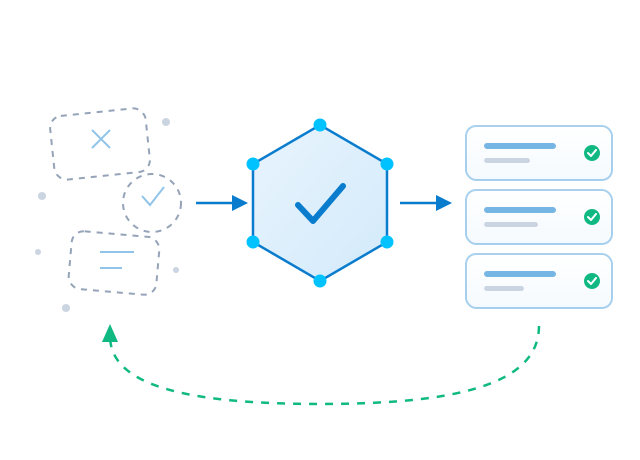
A deliberately short loop. Most tracks move from problem statement to a reviewed, documented artefact within a single quarter.
Frame the Problem
We start from a real constraint observed in an engagement — not a technology looking for a use case. Success criteria are agreed before any code is written.
Prototype & Measure
A time-boxed build against production-representative data and load, instrumented so the results are measured rather than asserted.
Architecture Review
The design is assessed against the six pillars by engineers who were not on the build. Gaps are either fixed or documented as explicit trade-offs.
Publish & Reuse
What passes becomes a reference architecture, a Terraform module, or a platform capability — versioned, documented, and available to every engagement.


